
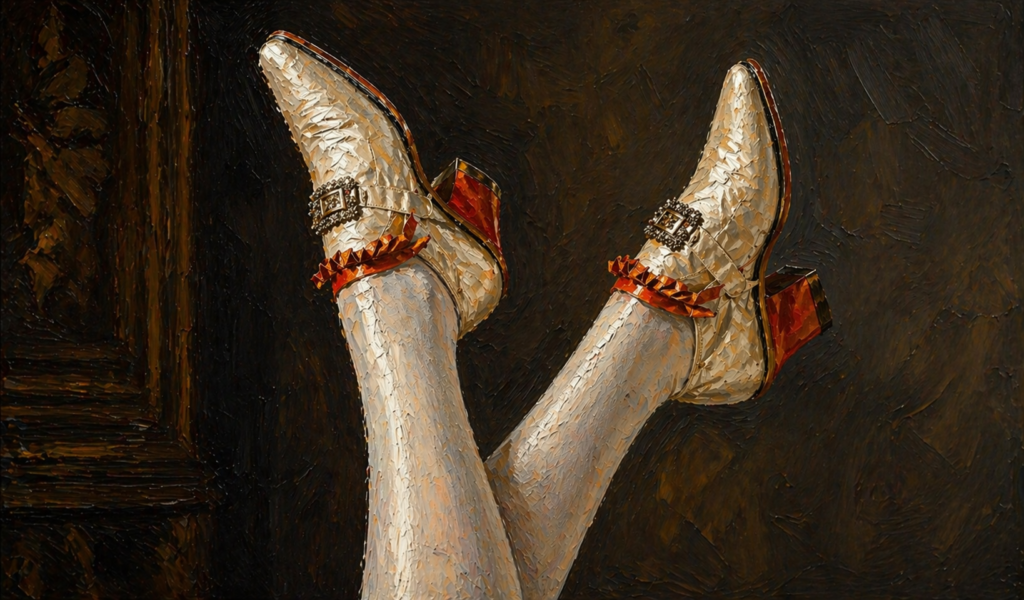
Picture in your mind, a man on horseback, going 40 kilometres an hour. The horse is giving everything it’s got, yet the rider’s hands aren’t touching the horse at all. He’s standing up in the stirrups, both hands on his bow, ready to fire at the target rushing toward him.
What on earth is keeping this man from slipping and falling to his death?
The answer goes all the way back to 900 AD. It’s very very simple.
its the heel on his shoe.
But somewhere along the way, this heel and its purpose changed into something completely different.
What happened to it? Let’s explore this together.Designed as a tool, a weapon
The heel never began as a fashion thing. It was an engineered solution to a very specific problem.
When you’re on horseback at full speed, your feet naturally want to slide forward and through the stirrups. If this happens you are going to lose your balance, your aim is now ruined and your chance of losing your life due to falling off is now significantly higher. The heel acts as a brake.It keeps the foot inside the stirrup. a small ridge of leather that locks the foot in place and gives the ride a much more stable platform to ride.
This was a tool, designed by people who needed it to work.
but then Europe got its hands on it and it drastically changed.
From Weapon to Costume
So I said 900 AD right? well fast forward to 1599, almost 700 years where this heel is used as a tool for practical purposes.
and then the Persian ruler Shah Abbas, sent a diplomatic mission envoy across Europe. His riders naturally arrived on horseback, ready to fight, Heels and all.
And then it happens. The European aristocracy sees this and they lose their minds over the aesthetic of the design.. They wanted those shoes!
The thing is, the Europeans didn’t care for the practicality of it. just the looks.
A functional tool with metal reinforcements and dramatically increase the performance of the rider?
not interested!
Instead it was “look how cool i would look in those heels!!”
The tool that was built to perform and survive on the battlefield..
Poof – reduced to fashion in the blink of an eye and was now going to be turned into a costume for palace floors.
They completely disregarded the usefulness, and started wearing it in places the original designers would have found completely baffling.
But it gets worse… this is old europe afterall…
it gets worse?!
Size matters
It didn’t take long before the heel became a status symbol and when that happens it’s only a matter of time before someone starts to create rules about it.
so in 17th century Europe your heel was now a signal of your social rank.
Ordinary citizens were only allowed half an inch(1.2cm), Wealthy merchants could go up to a full inch(2.5cm). Knights could claim an inch and a half.(3.8cm) Nobles would adorn 2 full inches(5cm) and if you were a prince you could climb atop your 2 and a half inch shoe(6.3cm) and Nobody else was allowed near it.
Think about how practical this really was, one look down at peoples feet and you instantly knew exactly where they belonged in society, and thus you knew how to behave towards this person, quite clever really.
You didn’t need any conversation or introductions, just look down.
And the higher the heal the more it would say about specific things.
you see the heel that high isn’t very practical.,. It’s difficult to run, fight, or even walk in these things so what it really signalled was “I don’t need to walk properly, I ride in a carriage , I walk on smooth marble floors and i don’t need to fetch or fight anything, I have people to do that for me”.
All in one look. But naturally one guy had to be the extremist…
Red Means Royalty. Red Means Blood.
King Louis XIV ( the fourteenth) of France was a mere 5’4″ (163cm) tall.
In an era where physical presence meant , well.. everything.. This was a problem. and Louis was well aware.
He came up with the solution that was a pair of heels with an astonishing 3.9 inches ( 10cm). But he didnt stop there.. no no..
He had them decorated, with tiny hand painted battle scenes of all things.
But it gets better,, or worse haha, depending on what you think.
He had the heels painted red. Very very bold colour to wear on your feet back then.
A deep and VERY expensive red made from crushed cochineal insects. It was so costly that most people even then noblemen would be able to afford to own..well..anything in that colour.
The signals were very clear, I’m the highest in society, I’m obscenely rich and not afraid to wear the colour of blood.. The power of both war and peacetime, all represented on the bottom of a shoe.
And then he made it exclusive. Only his very closest and most trusted nobles were permitted to wear red heels at court. so it changed from fashion to status. a very visible physical manifestation of who was in the king’s favour, and who wasn’t.
You could see the hierarchy from across entire rooms, and everyone wanted in.
very clever Louis, very clever.
It was never about gender. or was it?
Here is where heels get interesting.
If you mention “high heels” today, most people instantly think of a woman’s shoe. with a long stiletto.
But back in the 1600s things were quite different.
you see women only started to wear heels around this time. and the common assumption is that they borrowed the look from the men. But this simply wasn’t the case.
The women weren’t blind, they looked at the heels and saw it for what it represented.
The status, the elevation, the distance from ordinary life, and they wanted it just as much as the men did. They wanted to look like nobility and the heel was the fastest way to get there. But the women wearing these heels did not sit well with the men, they were not happy about it. At this age equality was NOT a thing, men had all the rights and women had very little. They spent years developing this heel system, it didn’t happen overnight.
all the work put in to distance themselves from ordinary people. and now even the women were allowed! Imagine you were the creator of a designer’s purse being purchased for 20.000 per bag,, now all of a sudden copies of your bag are on every shelf in every store for 20. How would that feel? you probably wouldn’t feel important, unique or special any longer, and this kind of emotion is just about what went through all these men.
The heel hadn’t changed but the exclusiveness was gone.
What do you think the men did then? when they felt threatened?
Naturally they went to great lengths to defend their lifestyle, and they became quite devious about it. They made the women stand out.. they started gossiping in the corners and spread rumors and blame on these women.. you know how far they went?
they went all the way…like…really far!
In 1770, women wearing high heels, to attract a man into marriage, were at high risk of being prosecuted for witchcraft. That’s how far they went.
Witchcraft, for wearing shoes.
The Ridicule
Speaking of the 1770s , at this point in time a group of young British men had returned from travel. A grand tour of Europe, The state of these men is something that you could only describe as,,,complete loss of proportion..
They called themselves The Macarony Club. These men wore Towering wigs, think Marge Simpson’s hair, just worse. and heels so high they were practically unusable as foot wear. And these guys thought they were the bomb. they thought everyone was going to look at them in awe and envy and they’d be the men of the hour.
The newspapers thought otherwise..
The drawings and articles were utterly merciless. These men were drawn as absolutely ridiculous clowns and they exaggerated their looks to make them look absolutely laughable. And the heels were some of the most noticeable in the drawings.
Within a short time, the Macaroni club became a beacon for everything a man..shouldnt be.
And the men in the rest of society reacted quite quick
Sudden exit.
No man wanted to be compared to the ridiculed Macaronis.
and almost overnight the heel just vanishes from mens fashion.
The Macaronis reputation had created the signal that wearing heels was now the opposite of masculine and power. Instead the signal of heels was ridicule, feeble, low status and powerless. And nobody, regardless of their place in society, wanted to be connected to that.
What ended up replacing the heel wasn’t just flat shoes though, they began making shoes with an entirely new approach, dark colours and simple cuts. Nothing decorative about them really and they were actually usable for practical situations.
Historians like to call this era “The Great Male Renunciation” ; it was the moment that men collectively decided that extravagance was no longer masculine. Practicality was now the new power move.
But the heels didn’t disappear
The Heel Outlived Everyone Who Tried to Define It
Because you probably guessed it.. The women kept their heels.
As men gave up the heels the meaning and importance of the heel started to shift.
From a masculine to a feminine thing.
So this tool that had once been a symbol of military function and clever ingenuity. was now associated with the completely opposite. Seduction.
The thing that used to signal power, social rank had now become a signal of manipulation, deception and unfair advantage.
The heel is still very much alive today., and now signals other things as well.
it still functions as a tool.. horse riding is still greatly dependent on the heel.
And all the seductive traits probably still follow.
but femininity , grace, class and elegance also follows the heel now.
It depends on who wears it, and how they wear it.
Even men are wearing heels as a fashion statement again, just without the social rules about heel size and so on.
Some things will live forever, the heel might just be one of them.
The shoe never changed,, but we did.
